How to Teach a Yorkie to Shake
Teaching a headstrong Yorkshire Terrier to shake hands can feel surprisingly tricky when their tiny paws seem dedicated to running the household rather than taking direction. However, this charming trick is one of the best ways to build focus, strengthen your bond, and make paw handling easier during grooming. This step-by-step guide outlines a simple, positive method to teach your Yorkie to offer their paw reliably without frustration.
Preparing Your Yorkie for Shake Training
Before diving into the physical mechanics of the shake command, setting up the right environment and having proper rewards on hand is critical. Yorkshire Terriers were originally bred to work independently, which means they possess a big personality packed into a very small frame. If a training session feels boring, confusing, or overly restrictive, your Yorkie will likely wander off, find a squeaky toy, or demand-bark for attention. By structuring your setup properly from the very beginning, you set your pint-sized companion up for immediate success.
Gathering the Right High-Value Treats and Tools
Because Yorkies have minuscule stomachs, standard dog treats are far too big and will quickly fill them up or cause tummy upset. You need micro-sized, soft, and extremely fragrant rewards that can be swallowed instantly without pausing the momentum of your lesson. You can easily order small-bite training treats, treat pouches, and training clickers on Amazon to keep your hands free and your rewards instantly accessible.
When choosing rewards, look for treats that can be broken down into pieces the size of a pea. Liver bits, tiny slivers of cooked chicken breast, or specialized low-calorie puppy rewards work exceptionally well. Pairing these treats with a training clicker or a crisp verbal marker like “Yes!” helps your dog pinpoint the exact millisecond they performed the correct action. If you want structured video instruction alongside your physical practice, joining an online dog training school like BAXTER & Bella can give you a clear roadmap for mastering basic home etiquette and trick training side by side.
Using the right rewards keeps motivation high without overloading your pup on calories. To dive deeper into what rewards work best for toy breeds, check out our guide on the Best Treats for Training a Yorkie.
Setting the Environment and Understanding Terrier Mindset
Environment plays a massive role in how quickly a toy terrier absorbs new skills. Choose a quiet room with minimal foot traffic, away from window views where neighborhood squirrels might distract them. Place a non-slip rug or yoga mat on the floor so your Yorkie does not slide around on slippery hardwood or tile while trying to shift their weight onto three legs.
Keep your training sessions extremely short. Three to five minutes, two or three times a day, is far more effective for a Yorkie than a grueling twenty-minute session. A young terrier’s attention span burns out quickly, and quitting while they are still enthusiastic leaves them eager for the next session. Always approach these sessions with enthusiasm and patience, leaning heavily on Positive Reinforcement Training for Yorkies to ensure your pup views working with you as an exciting game rather than a chore.
| Training Stage | Session Duration | Treat Frequency | Primary Goal |
|---|---|---|---|
| Stage 1: Paw-to-Hand Pawing | 2 to 3 minutes | Every single paw touch | Encourage natural paw lifting toward a closed fist. |
| Stage 2: Adding Verbal Cue | 3 to 5 minutes | Every successful response | Associate the vocal command “Shake” with the paw movement. |
| Stage 3: Open Hand Shake | 3 to 5 minutes | 80% of successful reps | Transition from a closed treat fist to an open palm. |
| Stage 4: Proofing & Distractions | 5 minutes | Intermittent / Random | Execute command in new environments without visible lures. |
Step-by-Step Method to Teach the Paw Shake
Teaching a dog to shake relies on a technique called “shaping”—capturing a natural behavior your dog already does and refining it into a deliberate trick. Yorkies naturally use their front paws to investigate items, scratch at doors, or ask for belly rubs. By leveraging this innate pawing behavior, you can teach the “shake” command in clear, stress-free steps.
Step 1: Capturing the Natural Paw Touch
Start by asking your Yorkie to sit on your non-slip surface. Sit on the floor directly in front of them so you are at eye level, which reduces any feeling of intimidation.
- Take a small, high-value treat and enclose it tightly inside your fist.
- Hold your closed fist directly in front of your Yorkie, roughly an inch or two away from their chest at knee level. Do not hold it too high, or they will jump up, and do not hold it on the floor, or they will lay down.
- Remain completely silent. Do not say “shake,” “paw,” or their name yet.
- Allow your Yorkie to sniff, lick, or nudge your hand with their nose. Ignore these behaviors completely.
- The moment your Yorkie gets curious or frustrated and lifts a paw to touch your hand, immediately click your clicker or say “Yes!” open your hand, and give them the treat.
Repeat this process several times. Most Yorkies will figure out within a couple of minutes that sniffing gets no response, but touching your hand with a paw instantly opens the vault. If you are working on foundational foundation skills alongside trick training, review How to Teach a Yorkie Basic Commands to keep your overall communication consistent.
Step 2: Introducing the Verbal Cue and Hand Gesture
Once your Yorkie is enthusiastically slamming their paw against your closed fist eight out of ten times without hesitation, it is time to name the behavior. Dogs do not naturally speak human language, so adding the vocal command too early just creates background noise.
- Say the word “Shake” (or “Paw”) clearly, just once, in a cheerful tone.
- Immediately present your closed fist in front of them as before.
- As soon as their paw taps your hand, mark it with “Yes!” or a click, and deliver the reward.
- Repeat this sequence 10 to 15 times over a few micro-sessions.
The goal here is for your dog to build an association between the word “Shake,” the presentation of your hand, and the physical act of lifting their foot. If you prefer using precise timing devices during this phase, incorporating Clicker Training a Yorkie can significantly speed up how quickly they make the mental connection.
Step 3: Transitioning to an Open Palm and Fading Lures
Now that your dog understands the vocal command and the underlying concept, you must phase out holding the treat inside your hand. Otherwise, your Yorkie will only perform when they physically smell food in your palm.
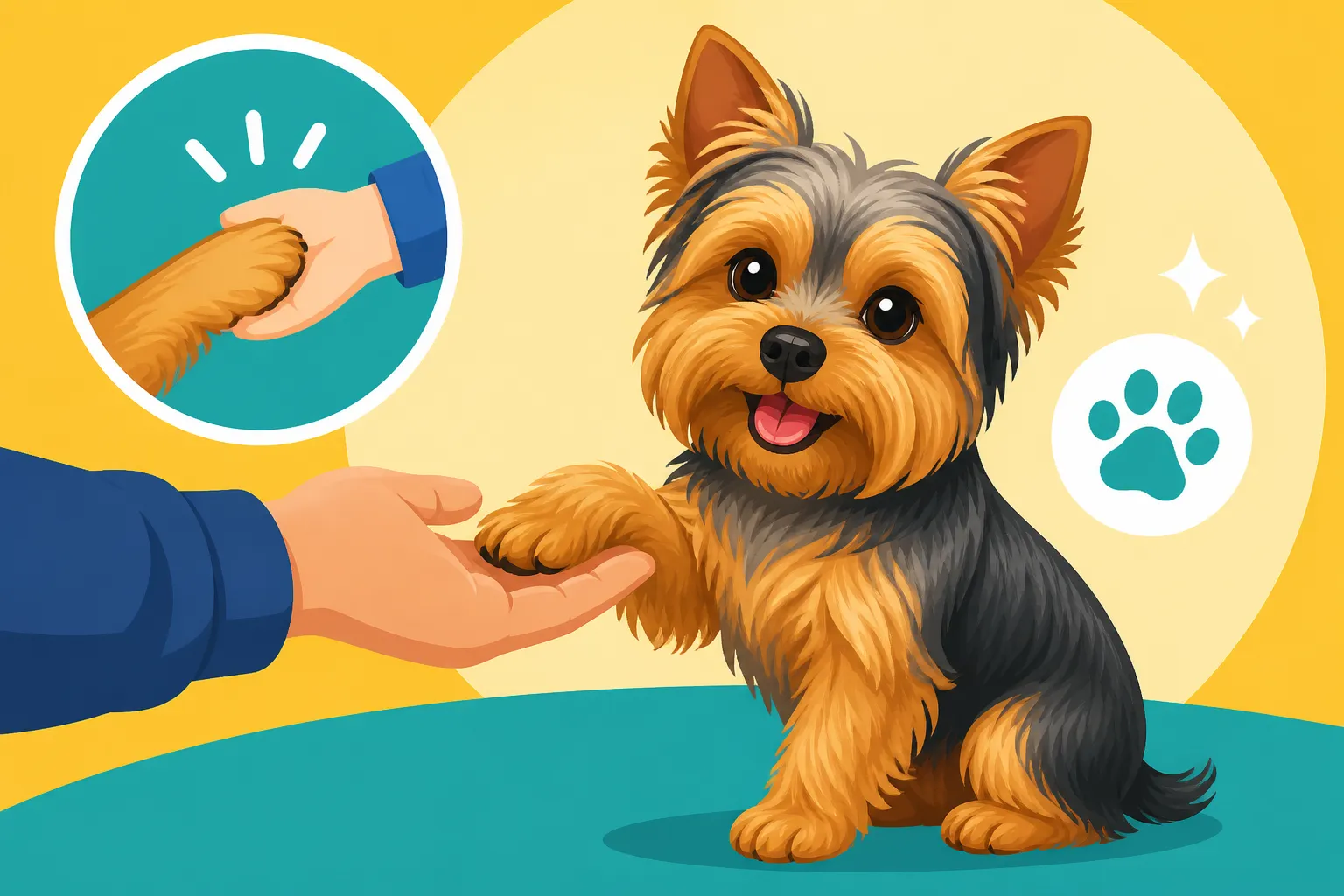
- Present an open, flat hand toward your Yorkie with your palm facing upward, as if offering a traditional handshake, and say “Shake.”
- Keep your treat hidden in your opposite hand behind your back or inside a treat pouch attached to your waist.
- The moment your Yorkie places their paw into your empty, open palm, mark the action with your verbal bridge (“Yes!”), then immediately deliver the reward from your other hand.
- Gently cradle their paw for a split second before releasing it and showering them with enthusiastic verbal praise.
If you hit a roadblock during this stage, online pet community forums and digital training platforms such as BAXTER & Bella can provide troubleshooting videos that demonstrate exact hand positioning to keep your dog focused.
Troubleshooting Common Yorkie Paw Shake Challenges
Even with a crystal-clear plan, training rarely follows a perfectly straight line. Yorkshire Terriers possess distinct personality traits that can present unique challenges during trick training. Recognizing these hurdles early keeps sessions positive and prevents bad habits from forming.
Handling Over-Excited Nipping or Biting
When confronted with a closed fist holding a smelly piece of chicken, some Yorkies become overly intense. Instead of using their paws, they might nibble, mouth, or actively try to pry your fingers open with their teeth.
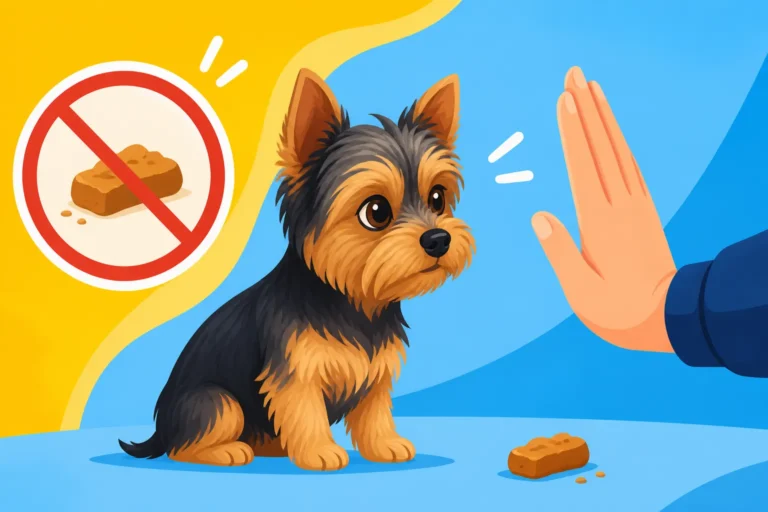
If your Yorkie starts mouthy behavior, do not yell or yank your hand away dramatically, as this can be interpreted as a fun game of chase. Instead, gently pull your hand back to your chest, turn your eyes away for five seconds, and reset. Re-offer your fist slightly lower. If they continue to mouth your hand, try placing the treat under a small, flat plastic cup or upside-down coaster on the floor. When they paw at the cup to get to the food, mark the touch and reward them. If your dog is still young and navigating general mouthiness, reading up on the Yorkie Puppy Biting Phase Explained will give you additional strategies to curb unwanted teeth contact.
Overcoming Stubbornness and Loss of Interest
If your Yorkie turns their head away, starts sniffing the floor, or grooms themselves mid-session, they are signaling that they are either confused, overwhelmed, or unmotivated.
- Check your treat value: Dry kibble rarely cuts it for a terrier learning a brand-new skill. Upgrade to freeze-dried liver or small bits of cheese.
- Shorten the duration: Cut your sessions down to ninety seconds. End the session on a high note while they are still begging for more.
- Lower the criteria: If your dog cannot figure out how to touch your hand, reward them for simply lifting their paw off the ground even a millimeter. Build up to full contact gradually.
When dealing with an extra spicy terrier attitude, consulting our guide on How to Train a Stubborn Yorkie can offer valuable perspective on keeping motivation high.
Addressing Wild Scrabbling or Wrong Paws
Sometimes a Yorkie gets too enthusiastic and begins madly scratching at your hand with both front paws or frantically offering rapid-fire behaviors like laying down, sitting, and rolling over all at once. This is often referred to as “behavior throwing.”
When this happens, completely freeze. Keep your hand flat and still, avoiding any movement or vocal feedback until your dog pauses and settles down. Wait for a single, deliberate paw placement rather than chaotic scratching. Rewarding calm, deliberate movement teaches self-control. You can also mix in some Mental Stimulation Games for Yorkies between training sessions to burn off excess mental energy so they arrive at trick practice focused and calm.
Building Advanced Paw Tricks and Real-World Applications
Once your Yorkie has mastered the standard shake on command, you can use this foundation to teach fun variations and practical life skills. Trick training is not just for entertaining friends; it serves as a functional tool for daily care.
Upgrading Shake to High Five and Wave
Transitioning a basic shake into a “High Five” or a “Wave” is surprisingly simple once the foundation is solid:
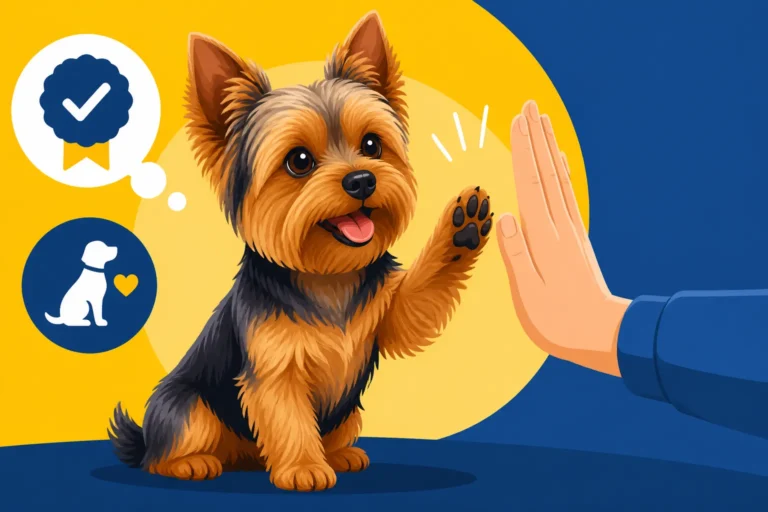
- For High Five: Hold your open palm vertically (facing your dog like a stop sign) rather than horizontally flat. Say “High Five!” and reward them when their paw touches your raised palm. Gradually raise your hand height until it sits at their forehead level. For a detailed breakdown of this transition, check out our tutorial on How to Teach a Yorkie to High Five.
- For Wave: Ask for a High Five, but just as your Yorkie lifts their paw to touch your vertical palm, pull your hand back an inch so their paw hovers in mid-air. Mark the air-touch with “Yes!” and reward. Add the command “Wave!” to capture the cute air gesture.
Using Paw Handling for Daily Maintenance
One of the greatest hidden benefits of teaching the shake command is desensitizing your Yorkshire Terrier to having their legs and paws touched. Many toy dogs are notoriously sensitive about their feet, making routine nail trims, paw wiping after rainy walks, and coat detangling a battle.
By turning paw touch into a rewarding game, your dog develops a positive emotional association with human hands touching their feet. Practice asking for a shake, holding their paw gently for two seconds, giving a treat, and letting go. Over time, extend the duration of the hold, gently press their toe pads, and reward them for remaining relaxed.
Incorporating Shake into Calm Greeting Routines
Yorkies are famous for their fiery alertness and propensity to bark hysterically when new people enter the home. You can use the shake command to redirect that excited energy into a polite, structured behavior.
When guests arrive, instead of allowing your terrier to jump or dart around the front door, put them in a sit and ask your guest to offer an open hand for a shake. Shifting your dog’s brain into “work and reward” mode gives them an alternative task, replacing frantic door-barking with a charming, polite greeting. If door excitement remains an ongoing project in your household, combining this trick with strategies from How to Stop a Yorkie from Barking At Strangers will create a much quieter entryway.
With consistent practice, high-value rewards, and micro-sessions tailored to your dog’s personality, your Yorkshire Terrier will be offering their paw with confidence and pride. Keep sessions fun, celebrate the tiny victories, and enjoy watching your brilliant little terrier shine.
Disclaimer
This article is for general informational purposes only and does not constitute professional advice. Laws, prices and regulations vary by location and change over time. Consult a qualified professional for guidance on your specific situation.