How to Teach a Yorkie to Spin
Trying to teach your energetic Yorkshire Terrier new tricks can sometimes feel like trying to herd a flock of squirrels – they're smart, but their attention spans can be, well, terrier-like. Many Yorkie parents yearn for fun, engaging ways to bond with their tiny companions and provide mental stimulation that goes beyond just walks. This comprehensive guide is here to walk you through the process of teaching your Yorkie the super cute "spin" trick, breaking down every step to make it enjoyable and successful for both of you.
Why Teach Your Yorkie to Spin? Beyond Just a Cute Trick
When you think about teaching a dog to spin, it might just seem like a party trick, something to show off to friends. But for a Yorkshire Terrier, a breed known for its intelligence and often boundless energy, learning new commands and tricks like "spin" offers a wealth of benefits that extend far beyond mere entertainment. It’s an investment in their well-being and your relationship.
Boosting Mental Agility and Engagement
Yorkies, despite their small stature, have big brains that thrive on challenges. Leaving them without adequate mental stimulation can lead to boredom, and a bored Yorkie is often a mischievous Yorkie, potentially inventing their own "games" like excessive barking or chewing things they shouldn't. Teaching them complex behaviors such as spinning requires them to think, process information, and use their problem-solving skills. This mental workout is just as important as physical exercise for their overall health and happiness.
Think of it like us humans doing a crossword puzzle or learning a new skill; it keeps our minds sharp. For your Yorkie, figuring out the "spin" involves understanding a new body movement, associating it with a verbal cue, and connecting that action to a reward. This entire cognitive process helps build their confidence and keeps them engaged in a positive way. It’s not just about the outcome, but the journey of learning itself.
A mentally stimulated Yorkie is generally a happier, better-behaved dog. This kind of engagement can also help address common Yorkshire Terrier Behavior Problems and Solutions by redirecting their inherent intelligence and drive into constructive activities rather than destructive ones.
Strengthening Your Bond
Training is one of the most powerful ways to build a deeper connection with your dog. When you engage in positive reinforcement training, you're not just teaching commands; you're communicating, building trust, and creating a shared language. Each successful "spin" isn't just a trick performed; it's a moment of connection where your Yorkie understands your request and you acknowledge their effort with praise and reward. This back-and-forth interaction fosters a strong sense of partnership.
Your Yorkie looks to you for guidance, reassurance, and fun. When you take the time to patiently teach them something new, it reinforces your role as a benevolent leader and strengthens their reliance and affection for you. These shared experiences create lasting memories and a sense of teamwork that can carry over into other aspects of your life together. It also shows them that you're a source of fun and good things, making them more likely to want to engage with you in the future.
This consistent, positive interaction during training sessions contributes significantly to a well-adjusted and secure pet, helping them feel more confident and loved.
Channeling Energy Positively
Yorkshire Terriers are little bundles of energy. While they don't require hours of intense running like some larger breeds, they do need regular outlets for their zest for life. Without constructive ways to expend this energy, it can sometimes manifest as hyperactivity or anxious behaviors. Teaching tricks like "spin" provides an excellent mental and physical outlet, even within the confines of your living room.
A few minutes of focused trick training can be surprisingly tiring for a small dog, as it engages both their mind and body. Instead of letting that energy lead to endless barking at passersby or frantic zoomies, you can channel it into a fun, productive activity. This is particularly useful on days when outdoor exercise might be limited due to bad weather or your own schedule. It offers a structured way to release pent-up energy, leaving your Yorkie feeling satisfied and ready for a good nap.
Incorporating tricks into their routine helps in managing their overall Yorkshire Terrier Exercise Needs. Even short bursts of training can make a big difference in their daily energy expenditure and overall contentment.
Essential Preparations Before You Start Spinning
Before you dive headfirst into the exciting world of teaching your Yorkie to spin, a little preparation can go a long way. Setting the stage correctly will ensure your training sessions are effective, positive, and free from unnecessary frustration. Rushing into it without the right tools or understanding can lead to confusion for your tiny learner and make the process much harder.
Gathering the Right Tools and Treats
The success of any training endeavor with a Yorkie often hinges on having the right motivators and equipment. These little dogs are highly food-motivated, but the type of treat matters immensely.
Firstly, you'll need high-value treats. These aren't their everyday kibble; they should be small, soft, incredibly tempting, and easy for your Yorkie to chew and swallow quickly without distraction. Think tiny pieces of cooked chicken, cheese, or specialized training treats. Brands like Wellness Soft Puppy Bites or Zuke's Mini Naturals are often big hits. You can find a wide variety of suitable options on Amazon, making it easy to experiment and find your Yorkie's absolute favorite. The goal is for them to be so excited about the treat that they're willing to work for it.
Secondly, consider a clicker. While not strictly mandatory, a clicker can be a powerful tool for Clicker Training a Yorkie. It acts as a precise marker, instantly telling your dog the exact moment they performed the desired action, followed immediately by a treat. This clarity speeds up the learning process significantly. If you're new to clicker training, spend a few sessions simply pairing the click with a treat so your Yorkie understands "click = treat."
Finally, ensure you have a distraction-free pouch or pocket for your treats. Fumbling with bags or containers can break your Yorkie's focus, so having treats readily accessible is key. For more detailed advice on what to use, check out our guide on Best Treats for Training a Yorkie.
Choosing the Ideal Training Environment
The environment where you choose to train your Yorkie plays a crucial role in their ability to focus and learn. For initial training sessions, you want a space that is as free from distractions as possible. This means no other pets, no loud noises, no bustling foot traffic, and ideally, a familiar area where your Yorkie already feels comfortable and secure.
A quiet corner of your living room, a bedroom with the door closed, or even a small, fenced-in area of your yard if it's truly private can be ideal. The less stimuli competing for your Yorkie's attention, the more likely they are to concentrate on you and the task at hand. Remember, Yorkies are small, and the world can seem like a very big, overwhelming place, so minimizing potential stressors is vital.
As your Yorkie starts to grasp the "spin" command, you can gradually introduce more challenging environments to help generalize the behavior. This means practicing in different rooms, then perhaps in your backyard, and eventually in mildly distracting public spaces. But for the initial learning phase, keep it simple and calm.
Understanding Your Yorkie's Learning Style
Every dog is an individual, and Yorkies are no exception. Some might be visual learners who respond best to hand signals, while others might be more audibly driven, picking up on verbal cues quickly. Observing your own dog's reactions during previous interactions can give you clues. Are they quick to follow your hand if you're guiding them, or do they perk up more to your voice?
Patience is paramount, especially with small breeds that can sometimes have a stubborn streak or get easily overwhelmed. Keep training sessions short, generally 5-10 minutes, especially when first starting out. Multiple short sessions throughout the day are far more effective than one long, drawn-out session where your Yorkie might lose interest or get fatigued. Always end on a positive note, even if it means asking for a simpler, already known command and rewarding them enthusiastically.
Knowing your Yorkie's unique personality—whether they are a bold explorer or a timid observer—will help you tailor your approach. For a shy Yorkie, you might need to build confidence before expecting them to perform elaborate tricks. For a boisterous one, trick training can be a fantastic way to How to Calm a Hyper Yorkie by focusing their energy. A company like BAXTER & Bella, known for its online puppy training programs, often emphasizes understanding your dog's individual learning pace, which is a valuable approach for any trick.
Step-by-Step Guide to Teaching the Spin Command
Now that you're armed with the right tools and a clear understanding of your Yorkie's needs, it's time to dive into the actual training. Remember, consistency and positive reinforcement are your best friends here. Don't get discouraged if your Yorkie doesn't get it right away; some dogs pick things up faster than others, and that's perfectly normal.
Lure and Follow: The Initial Movement
This is where the magic begins, and it's all about using a high-value treat as a lure. Hold a small, enticing treat between your thumb and forefinger. Get down to your Yorkie's level to make eye contact and ensure they are focused on you and the treat.
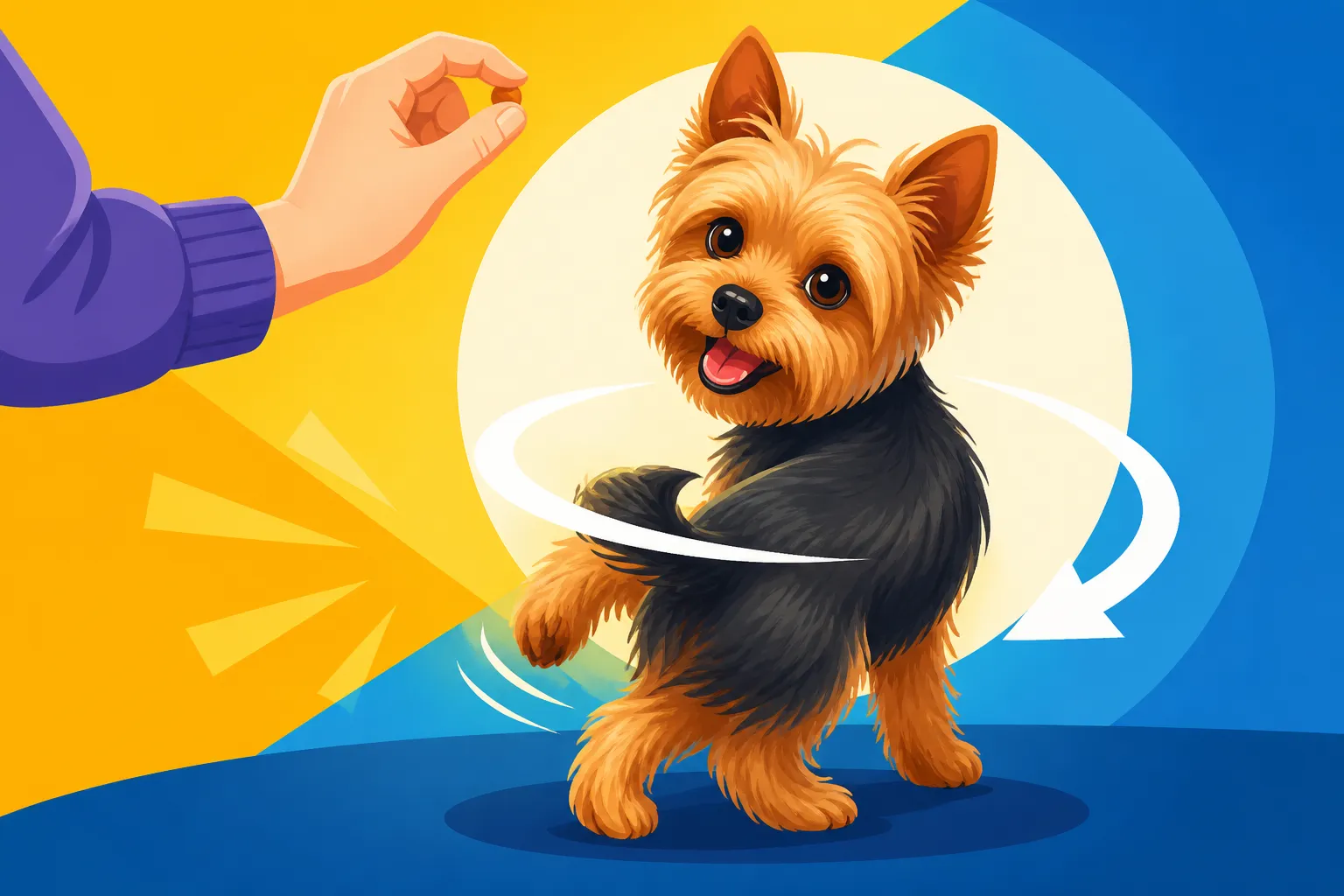
Now, hold the treat close to your Yorkie's nose. Slowly move your hand in a circular motion, tracing an invisible circle just in front of their nose and head. The goal is to get your Yorkie to follow the treat with their nose, which will naturally encourage their body to turn in a circle. As soon as their body completes one full circle, or even a significant portion of one, say "Yes!" or click your clicker, and immediately give them the treat.
Repeat this several times, always luring them in the same direction first (e.g., clockwise). You might notice that in the very beginning, your Yorkie only turns a quarter or half a circle. That's totally fine! Reward even the smallest approximation of the desired behavior. This is called "shaping" and it's a fundamental part of positive reinforcement training. Gradually, only reward them for larger and larger turns until they complete a full 360-degree spin. This initial phase is purely physical, building the muscle memory for the motion.
Don't rush this step. If your Yorkie is struggling, make the lure more obvious or use an even higher-value treat. Keep the energy light and positive, making it feel like a fun game rather than a chore. This foundational step is critical for teaching your Yorkie to move their body in the way you want.
Introducing the Verbal Cue and Hand Signal
Once your Yorkie is consistently following the lure and completing a full spin, it's time to add the verbal cue and a hand signal. Consistency is key here. Choose a clear, distinct word for the trick, like "Spin!" or "Turn!" You'll also want to create a unique hand signal – perhaps a circling motion with your finger or hand.
The trick is to layer these cues. Just as your Yorkie is about to start following your lure, say your verbal cue ("Spin!") and simultaneously make your hand signal. Immediately follow with the lure, guide them through the spin, and then "Yes!" or click and reward. Repeat this sequence: Verbal cue + Hand signal + Lure + Spin + Reward.
Do this for several sessions. The idea is for your Yorkie to start associating the word and the hand motion with the action of spinning. Eventually, they'll anticipate the spin based on the verbal and visual cues before you even present the lure.
Make sure your verbal cue is always the same tone and volume, and your hand signal is consistent. Avoid using too many words or making the hand signal overly complicated. Simple and clear is best for teaching a Yorkie new tricks. This careful pairing helps them understand what you're asking without relying solely on the food in your hand.
Fading the Lure and Reinforcing the Command
This is often the trickiest part, as it requires you to gradually remove the treat lure, allowing your Yorkie to perform the spin based on your verbal and hand signals alone.
Start by making the treat lure less obvious. Instead of holding the treat right at their nose, hold it slightly further away. Then, pretend you have a treat in your hand (an "empty hand lure"), but only reveal the actual treat after they've spun and you've clicked/said "Yes!".
As they become more proficient, you can start to reduce the size of the circular motion you make with your hand, eventually simplifying it to just your chosen hand signal. At this point, you should be able to give the verbal cue ("Spin!"), make the hand signal, and your Yorkie should complete the spin before you reach for the treat. Remember to always reward immediately after the desired action!
Don't be afraid to go back a step if your Yorkie gets confused. If they stop spinning, reintroduce the lure more clearly for a few repetitions, then try fading it again. This process requires patience and understanding. You're building a new level of comprehension, where the cue becomes the trigger for the behavior, not just the sight of the food.
Troubleshooting Common Challenges
Even with the best intentions, you might run into a few bumps along the road. It's totally normal for a Yorkie to have moments of confusion or disinterest.
One common issue is your Yorkie not following the lure. If this happens, re-evaluate your treats. Are they truly high-value enough? Try different types until you find something irresistible. Ensure you're training in a completely distraction-free environment. Sometimes, a Yorkie might simply be too tired or overstimulated. Take a break and try again later.
Another challenge is your Yorkie only doing part of the spin. If they stop halfway, go back to rewarding smaller turns, then gradually increase the expectation again. Ensure your lure motion is smooth and clear, guiding them through the full circle. Don't let them "cheat" by just moving their head; the goal is for their entire body to move.
If your Yorkie seems frustrated or gives up, it’s a sign that the session is too long or too difficult. End on a positive note with an easy command they know, like "sit," and then try again during a different short session. Yorkie Training Mistakes to Avoid often include pushing too hard or having unrealistic expectations. Remember, short, fun sessions are always better than long, frustrating ones. Keep it light, keep it positive, and celebrate every small victory!
Advanced Tips and Maintaining the Spin Trick
Once your Yorkshire Terrier is a master of the basic spin, the fun doesn't have to stop there! You can build on this foundation to make the trick even more impressive and keep your Yorkie mentally engaged. Think of it as adding layers to their repertoire, making them feel like a true canine superstar.
Adding Directional Cues and Variations
The next logical step after a consistent spin is to teach your Yorkie to spin in both directions. Initially, you likely taught them to spin clockwise. Now, you can introduce a separate verbal cue and hand signal for spinning counter-clockwise. For example, "Spin Right!" with a clockwise hand motion, and "Spin Left!" with a counter-clockwise hand motion.
You'll essentially repeat the entire luring and fading process for the new direction. Keep the sessions for each direction separate at first to avoid confusion. Once they understand both, you can start asking for them interchangeably, making it a more challenging and impressive trick. You can also teach them to do multiple spins in a row, building up their stamina and focus. For instance, cue "Spin Right, Right, Right!" and reward after the third completed turn.
Another fun variation is to incorporate the spin into a sequence of tricks. Imagine your Yorkie doing a "Sit, Stay, Spin Right, Paw!" – it's like a mini-routine! These kinds of complex sequences are fantastic for Mental Stimulation Games for Yorkies and showcase their intelligence beautifully. You could even integrate a "figure eight" where they spin around your legs, which is another step up in coordination and engagement.
Practicing in Different Settings
Just because your Yorkie can spin perfectly in your quiet living room doesn't mean they'll be able to do it at the busy dog park. To truly "proof" a trick, you need to practice it in a variety of environments with increasing levels of distraction. This helps your Yorkie generalize the command, meaning they understand "spin" means "spin" no matter where they are or what else is going on.
Start by practicing in different rooms of your house. Then, move to your backyard. Next, try a friend's house, or a quiet public park during off-peak hours. Gradually introduce more distractions, such as other people, mild street noises, or even other calm dogs (if your Yorkie is well-socialized). Each time you change the environment, you might need to briefly go back to using a more obvious lure or higher-value treats initially, as the new stimuli can be overwhelming.
This incremental exposure ensures that the trick becomes robust and reliable, which is a hallmark of a well-trained dog. It also helps your Yorkie build confidence in novel situations, knowing they can still perform and earn rewards even when the world around them is a bit more exciting.
Keeping Training Fun and Engaging
The most important aspect of maintaining any trick, especially one that requires repetition, is to keep it fun and engaging for your Yorkie. Training should always be a positive experience, a game you both enjoy, not a chore.
Vary your rewards: don't just use treats every single time. Sometimes, a super enthusiastic "Good spin!" followed by a favorite squeaky toy or a quick game of fetch is just as rewarding, if not more so. This prevents your Yorkie from becoming solely dependent on food and makes them more enthusiastic about training for its own sake.
Keep sessions short and sweet, typically no more than 5-10 minutes. Yorkies have tiny bladders and even tinier attention spans! Ending on a high note, with success and praise, makes them eager for the next session. If you or your Yorkie are having an "off" day, it's okay to skip a session or just do a few easy tricks they already know.
By consistently making training a joyful interaction, you're not just maintaining a trick; you're reinforcing the strong, loving bond you share with your Yorkshire Terrier. After all, the joy of learning together is one of the greatest gifts of pet ownership. For more general advice on maintaining a healthy, balanced life for your pet, you might find our article on How to Keep a Yorkshire Terrier Healthy helpful.
Disclaimer
The information provided in this guide is for general informational purposes only and does not constitute professional veterinary advice. Always consult with a qualified veterinarian or certified professional dog trainer for any concerns regarding your Yorkshire Terrier's health, behavior, or training needs. Individual results may vary based on your dog's temperament, age, past experiences, and your consistency in training.