How to Tell If a Yorkie Is Purebred
It’s a common scenario: you’ve welcomed an adorable Yorkshire Terrier into your home, full of personality and charm, and you adore them completely. But maybe you got them from a rescue, or a friend, or even a breeder whose legitimacy you’re now questioning, and you find yourself wondering, "Is my precious Yorkie truly a purebred?" It’s a valid question, stemming from a desire to understand your dog’s background, anticipate potential health issues, or simply confirm the lineage you believed you were getting. This comprehensive guide will walk you through the key indicators, from physical traits to behavioral cues and official documentation, to help you determine if your beloved companion is indeed a purebred Yorkshire Terrier.
Understanding the Official Yorkshire Terrier Breed Standard
When we talk about whether a Yorkie is "purebred," what we're really referring to is how closely they align with the official breed standard established by major kennel clubs like the American Kennel Club (AKC) or the Canadian Kennel Club (CKC). These standards are essentially the blueprint for the ideal Yorkshire Terrier, detailing everything from their physical appearance to their temperament. It’s not just about looks; it's about a consistent set of traits that have been carefully cultivated over generations.
Many people stumble into situations where they might believe they’re getting a purebred, only to realize later that there are some inconsistencies. Perhaps a "teacup" Yorkie, a term not recognized by any major kennel club, grows much larger than expected, or their coat color isn't quite right. Understanding the official standard is your first and most reliable step in discerning your dog's true heritage. It gives you a baseline to compare against, rather than relying on hearsay or the potentially misleading descriptions of less scrupulous sellers.
Key Physical Characteristics
The AKC standard for Yorkshire Terriers is quite specific about their appearance. We're looking for a compact, toy-sized dog with an erect, confident carriage. The overall impression should be one of alertness, intelligence, and self-importance. While individual variations occur, a purebred Yorkie will generally adhere closely to these defined features.
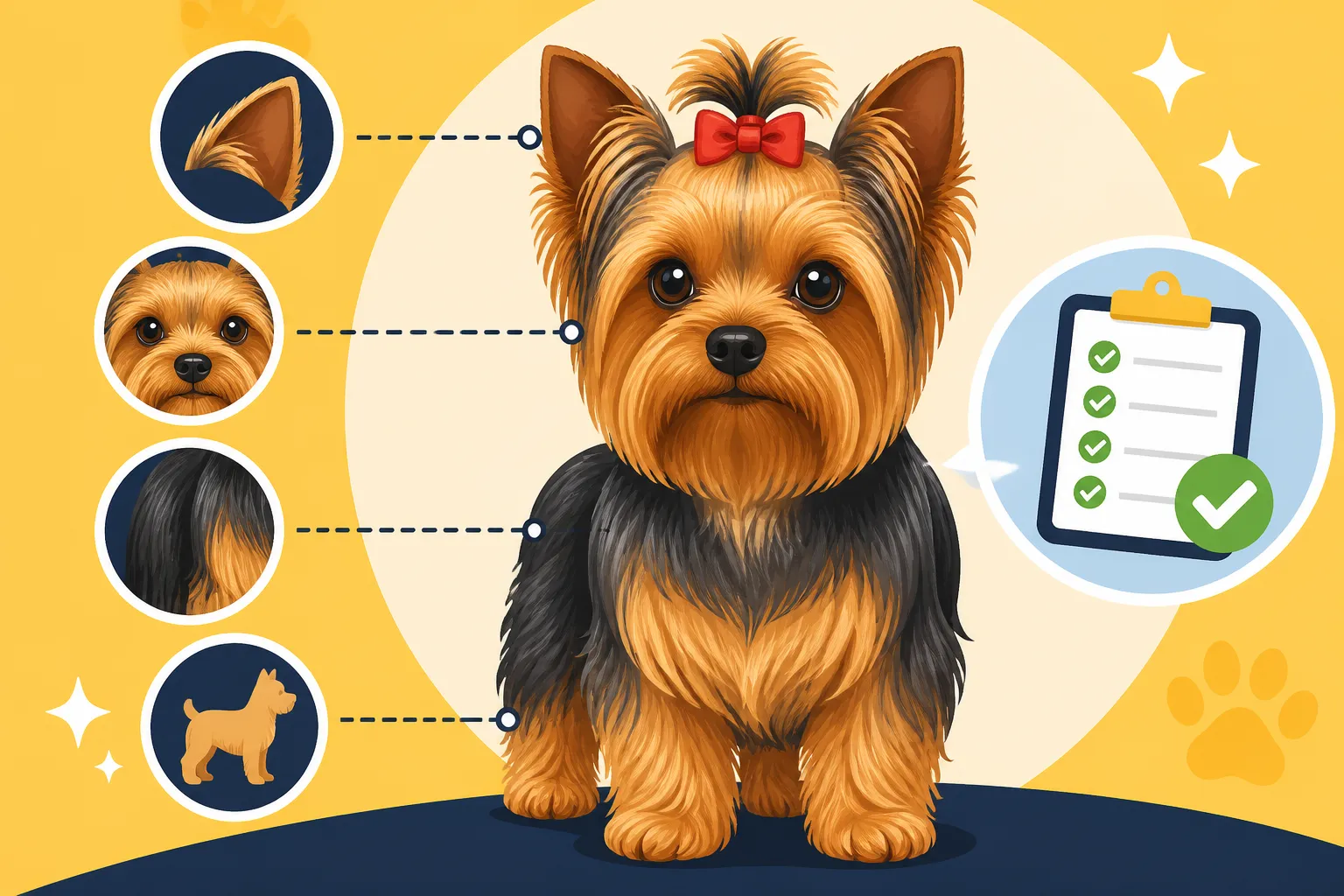
One of the most defining characteristics is their coat. It should be long, silky, and fine in texture, hanging straight down on either side of the body. The color is also critical: a purebred Yorkie displays a steel blue (not silvery blue or black) body and rich, bright tan on the head, chest, and legs. This isn't just any blue and tan; there's a specific tone and pattern expected. Any large black patches or significantly lighter tan areas might indicate a mixed breed. For a deeper dive into how their coat colors typically develop, you might find our article on Yorkshire Terrier Coat Color Changes helpful.
Temperament and Demeanor Markers
Beyond their looks, a purebred Yorkshire Terrier possesses a distinctive personality that’s often described as spirited, tenacious, and intelligent. They are truly terriers at heart, full of self-importance and an eagerness for adventure, despite their diminutive size. They can be quite vocal, making excellent little watchdogs, and are fiercely loyal to their families.
However, this feisty nature can sometimes manifest as stubbornness, especially during training. They can be prone to "small dog syndrome" if not properly socialized and trained. If your Yorkie is excessively timid, overly mellow to the point of being lethargic, or exhibits aggression beyond typical terrier assertiveness, it might be a subtle hint that there’s another breed influencing their disposition. Understanding Yorkshire Terrier Temperament and Personality can give you a clearer picture of what to expect.
Visual Cues and What to Look For
When assessing if a Yorkie is purebred, a thorough examination of their physical traits is paramount. While a photograph can offer a glimpse, nothing beats a hands-on look at their stature, coat, head, and eyes. These small details, when considered together, paint a comprehensive picture. It’s about more than just a passing resemblance; it’s about meeting a specific set of criteria.
Many people are drawn to Yorkies for their adorable, fluffy appearance, but it's important to differentiate between a cute puppy and one that fits the breed standard. Sometimes, what seems like a minor deviation can actually be a strong indicator of mixed ancestry. Remember that breeders who prioritize the standard will aim for consistency in these traits across their litters.
Coat Color and Texture
The signature coat of a purebred Yorkie is perhaps its most distinguishing feature. As mentioned, the AKC standard calls for a "steel blue" body, extending from the back of the head to the tip of the tail, with "rich tan" on the head and legs. This blue should be a deep, dark grey-blue, not black, silver, or light grey. The tan points should be a bright, vivid golden-tan, not pale cream or reddish. Puppies are born black and tan, and the blue develops as they mature, usually between 9 months and 3 years. This transition is a fascinating aspect of their development.
The texture is equally important. It should be fine, silky, and straight, resembling human hair rather than coarse or woolly fur. A dense, wiry, or cottony coat, or one that sheds excessively, is a strong indicator of mixed heritage. While a Yorkie’s hair requires consistent grooming to prevent matting, a truly purebred coat will maintain its silky quality. You can explore how to care for this unique coat in our Yorkshire Terrier Grooming Guide.
Size, Build, and Facial Features
Purebred Yorkies are small, compact dogs, typically weighing no more than seven pounds. They are well-proportioned, with a level back and a high-set tail that is customarily docked to a medium length (though docking practices vary by region and individual choice). Their legs should be straight and their feet round with black toenails. Any significant deviation in size or disproportionate body parts, such as unusually long legs or a very stocky build, could suggest a mix. If you're wondering about variations like "teacup" Yorkies, which are often just undersized individuals and prone to health issues, our article on Teacup Yorkie: What to Know provides crucial information.
Their head should be rather small and flat on top, not round like an apple. The muzzle should be of moderate length, not too short or too long. The eyes are dark, sparkling, and medium-sized, set to look straight ahead, with dark eye rims. Ears are V-shaped, small, and carried erect, not floppy or semi-erect (unless the puppy is very young and still developing muscle strength). A black nose is also a must. Subtle variations in any of these features could point away from a purebred lineage.
| Characteristic | Purebred Yorkshire Terrier Standard | Potential Mix/Non-Standard Indication |
|---|---|---|
| Weight | Max 7 pounds | Significantly over 7 pounds |
| Coat Color | Steel blue body, rich tan points | Black, silver, grey, cream, red body; pale or dull tan |
| Coat Texture | Fine, silky, straight, hair-like | Coarse, woolly, wiry, excessive shedding |
| Ears | Small, V-shaped, erect (adult) | Floppy, semi-erect (adult), overly large |
| Eyes | Dark, sparkling, medium, forward-set | Light-colored, bulging, or too small |
| Nose | Black | Pink or liver-colored |
| Body Build | Compact, well-proportioned, level back | Long-bodied, stocky, disproportionate |
The Definitive Proof: Documentation and DNA
While visual cues and temperament insights are incredibly helpful, the most ironclad way to confirm your Yorkie's purebred status is through official documentation and, increasingly, genetic testing. Relying solely on appearance can be misleading because mixes can sometimes closely resemble purebreds, or a purebred might have non-standard traits. Think of it like a human family tree – you can guess based on looks, but official records or a DNA test provide certainty.
Navigating the world of breeders and paperwork can be daunting, especially for first-time owners. It’s easy to be overwhelmed by jargon or to overlook critical details. That’s why arming yourself with knowledge about what constitutes proper documentation and the benefits of DNA testing is so important. This proactive approach ensures you have peace of mind about your Yorkie's lineage and potential Yorkshire Terrier genetic conditions.
Pedigree Papers and Breeder Information
The gold standard for proving purebred status is a pedigree certificate from a reputable kennel club, such as the AKC in the United States or the Kennel Club in the UK. This document traces your dog’s lineage back multiple generations, listing their ancestors and confirming that all recorded dogs are of the same breed. A responsible breeder will provide these papers upon purchase, often after proof of spay/neuter for pet-quality dogs. Be wary of breeders who offer papers only at an extra cost or claim they "lost" them.
When looking for a puppy, always ask about the parents' pedigrees and health clearances. A reputable breeder will be transparent about their dogs’ health history, screening for common issues like Yorkshire Terrier Patellar Luxation: Signs and Care or liver shunts. They should also be registered with their respective kennel club and be able to provide registration numbers. Our guide on How to Find a Reputable Yorkie Breeder can offer invaluable advice on this front, helping you ask the right questions and spot red flags. Furthermore, remember that the price of a Yorkie often reflects the care, breeding standards, and documentation involved, so exploring Yorkie Puppy Price by Bloodline can also be informative.
Genetic DNA Testing
In today's world, DNA testing has become an incredibly accurate and accessible tool for breed identification. Companies like Embark and Wisdom Panel offer comprehensive genetic tests that can determine a dog's breed composition with remarkable precision, often down to percentages of different breeds if they are a mix. These tests involve a simple cheek swab you can do at home, then mail back to the lab. Within a few weeks, you'll receive a detailed report.
Beyond just breed identification, many of these tests also screen for various genetic health conditions. This can be invaluable information for any dog owner, as it allows you to be proactive about your Yorkie's health and work with your vet on a tailored preventative care plan. For example, if the test reveals a predisposition to a condition common in Yorkies, you can be more vigilant. Some pet supply retailers, like Chewy, even offer these DNA test kits directly, making them easy to acquire. It's a fantastic way to gain objective, scientific confirmation of your dog's heritage.
Situations Where Identifying Purebred Status Matters
While the love for your dog is unconditional, knowing their purebred status can be important for several practical reasons. It’s not about loving them more or less; it’s about informed ownership and being prepared for what might come. Many pet parents find themselves in situations where this knowledge becomes particularly relevant, influencing their care choices, financial planning, and even their daily routine.
Perhaps you've adopted a Yorkie whose history is a mystery, or you're considering entering dog shows or breeding programs. In these scenarios, a clear understanding of their lineage is not just helpful but often necessary. It impacts everything from diet considerations to insurance plans, making it a valuable piece of information to possess.
Health and Anticipating Specific Conditions
Purebred dogs, including Yorkshire Terriers, are known to be predisposed to certain genetic health conditions due to their specific breeding lines. Conditions like Yorkshire Terrier Collapsing Trachea: Signs and Care, Yorkshire Terrier Patellar Luxation: Signs and Care, or Yorkie Hypoglycemia: Emergency Signs are more common in the breed. If your dog is a purebred Yorkie, you can work proactively with your veterinarian to monitor for these issues, implement preventative measures, and recognize early symptoms.
Conversely, if your dog is a mix, they might still inherit some of these predispositions, but they could also benefit from "hybrid vigor," which sometimes means a lower risk for certain breed-specific ailments. Knowing your dog's true breed composition through DNA testing can give your vet a much clearer picture of potential health risks, allowing for more targeted screenings and preventative care plans. This knowledge helps you become a more prepared and responsible pet parent, ensuring your furry friend lives the healthiest life possible.
Breeding and Showing Considerations
If you have aspirations of breeding your Yorkshire Terrier or entering them into conformation shows sanctioned by kennel clubs, then purebred status is absolutely non-negotiable. Only registered purebreds are eligible for these activities. Kennel clubs maintain strict standards, and any dog that does not meet the breed standard, or whose lineage cannot be definitively proven, will be disqualified. This is where those pedigree papers become essential.
Even if you’re not looking to show or breed, understanding the implications can shed light on why some breeders are so meticulous about documentation and genetic testing. They are not just selling pets; they are aiming to preserve and improve the breed. Knowing the criteria can also help you appreciate the efforts of ethical breeders and avoid those who might misrepresent their animals.
Insurance and Financial Planning
The cost of owning a Yorkie can fluctuate based on many factors, and health is a major one. When considering pet insurance, some providers might ask about your dog's breed, and knowledge of specific breed predispositions can influence policy recommendations or premiums. While all dogs can incur unexpected vet bills, knowing your Yorkie's purebred status allows you to better anticipate and budget for potential breed-specific health challenges.
Additionally, certain specialized care, like grooming for a long, silky coat, is a regular expense for purebred Yorkies. If your dog has a mixed coat that's more manageable, your grooming costs might differ. Financial planning for your pet extends beyond basic food and toys; it encompasses everything from routine vet visits to emergency care, and understanding your dog’s breed can help you make more informed budgetary decisions. Chewy, for example, offers a wide range of products tailored to the specific needs of breeds like Yorkies, from special shampoos to joint supplements, which can be part of your long-term financial planning.
Disclaimer
The information provided in this article is for general informational purposes only and does not constitute professional veterinary advice. Always consult with a qualified veterinarian for any health concerns or before making any decisions related to your pet's care.