How to Stop Yorkie Leash Pulling
There's nothing quite as frustrating as stepping out for a walk with your adorable Yorkshire Terrier, only for the pleasant stroll to turn into a tug-of-war. That tiny body can generate an incredible amount of force, leaving your arm aching and you feeling exasperated. If you're constantly battling a pulling Yorkie on the leash, you're not alone. This comprehensive guide will delve into the reasons behind this common behavior and provide actionable strategies to help you and your furry friend enjoy peaceful, loose-leash walks together.
Understanding Why Yorkies Pull on the Leash
It's easy to think your Yorkie is just being stubborn when they pull, but often, there are very good reasons for their behavior, rooted in their natural instincts and experiences. Understanding these underlying motivations is the first step towards effective training.
Their Terrier Instincts and High Energy
Yorkshire Terriers might be small in stature, but they carry the heart and heritage of working terriers. They were originally bred to hunt rats and other small vermin in textile mills, which means they have a natural drive, a keen sense of smell, and a propensity to explore with great enthusiasm. When you step outside, the world explodes with scents, sights, and sounds, triggering their innate curiosity and prey drive. That sudden lunge towards a rustling bush isn't always defiance; it's often their terrier instincts kicking in, urging them to investigate.
Furthermore, despite their size, Yorkies have a surprising amount of energy. If they haven't had enough mental and physical stimulation before a walk, that pent-up energy can manifest as pulling. They're simply eager to get moving, explore their territory, and burn off some steam. It's like a child who hasn't run around all day; they'll burst out the door ready to sprint! Recognizing this inherent drive helps us approach their training with more empathy and strategic planning.
Lack of Early Training and Socialization
Many leash pulling issues stem from a lack of consistent early training and proper socialization. If a Yorkie puppy isn't taught from day one what loose-leash walking means, they naturally learn that pulling gets them where they want to go faster. Every time they pull and you continue to move forward, even inadvertently, you're reinforcing that behavior. They're smart little dogs and quickly pick up on what works.
Moreover, if a Yorkie hasn't been adequately socialized as a puppy, new environments and encounters can be overwhelming or overly exciting. A dog who wasn't exposed to various sights, sounds, people, and other dogs during their critical developmental period (roughly 3-16 weeks) might react by lunging, barking, or pulling intensely when faced with novel stimuli. This isn't aggression; it's often anxiety, over-excitement, or simply not knowing how to appropriately interact with the world around them. Consistent and positive exposure, along with specific training, is key to building their confidence and manners on a leash. For more on this, check out our guide on how to Socialize a Yorkshire Terrier.
Over-Excitement and Sensory Overload
Imagine a world where every blade of grass holds a thousand fascinating smells, every distant bark is a potential interaction, and every passing car is a blur of captivating movement. That's often what a walk is like for your Yorkie! Their senses are incredibly heightened compared to ours, and the sheer volume of new information can lead to over-excitement. This sensory overload can make it difficult for them to focus on you or to remember their training.
When a Yorkie is overstimulated, their arousal levels spike, and they might simply forget everything they've learned about polite leash manners. They pull because they want to get to that interesting smell, greet that person, or chase that leaf. It’s not necessarily an act of defiance, but rather an overwhelming instinct taking over. Understanding that their little brains are processing a massive amount of data can help you tailor your training approach, perhaps starting in quieter environments and gradually introducing more distractions.
Essential Gear for Leash Training Success
Before you even begin implementing specific training techniques, having the right equipment is absolutely crucial. The wrong gear can exacerbate pulling and even cause discomfort or injury to your Yorkie.
Choosing the Right Harness
When it comes to small breeds like Yorkies, a harness is almost always preferred over a collar for walking. Their delicate tracheas are susceptible to damage from pulling against a collar, which can lead to issues like tracheal collapse, a common concern in Yorkshire Terriers. A harness distributes pressure across their chest and shoulders, protecting their neck.
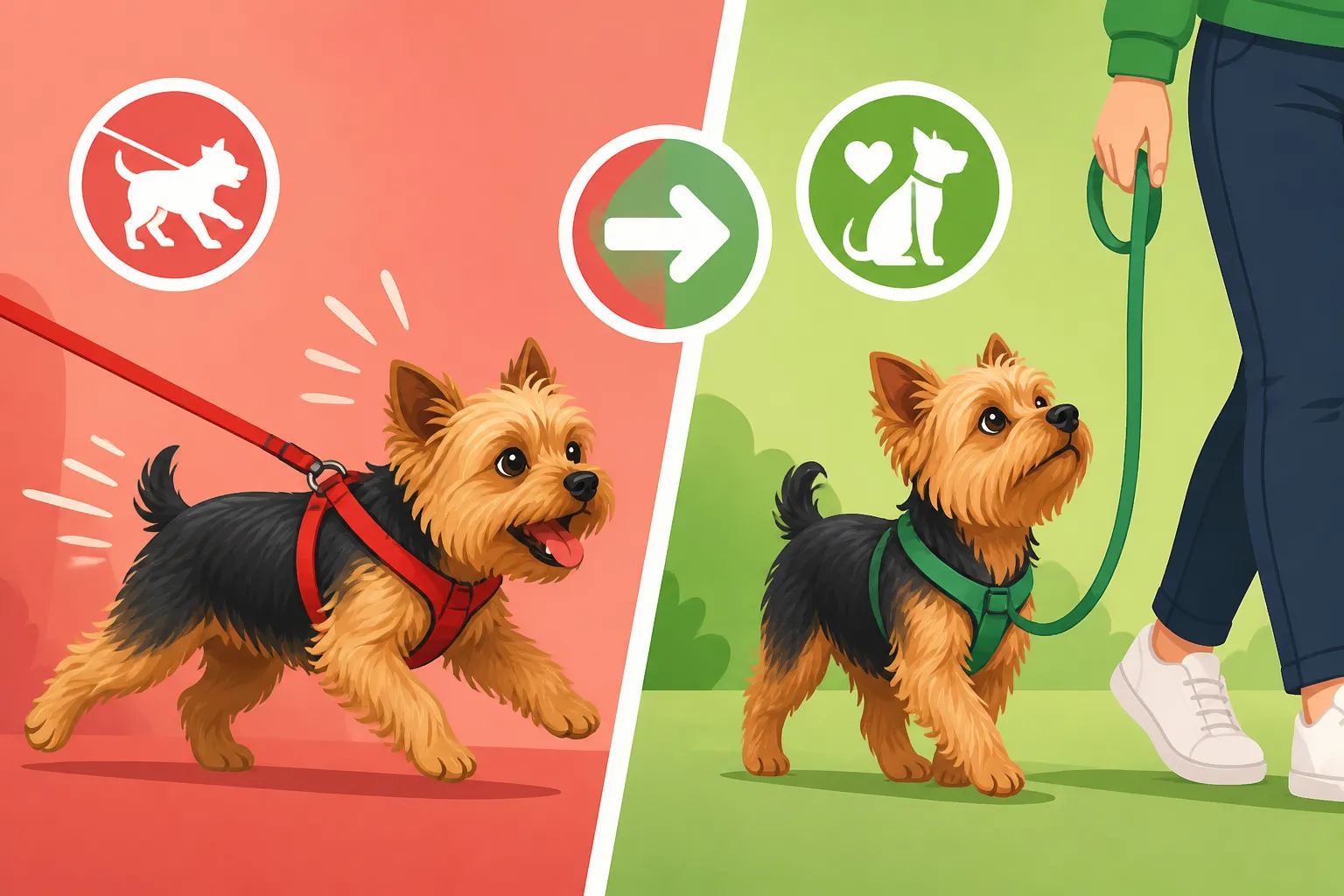
However, not all harnesses are created equal for leash pulling. A standard back-clip harness, while comfortable, can actually encourage pulling because it allows the dog to lean into it with their full weight, engaging their natural opposition reflex. For active pullers, a front-clip harness or a no-pull harness is often the game-changer. These harnesses have the leash attachment point on the dog's chest. When your Yorkie pulls, the leash redirects them gently to the side, turning them towards you instead of allowing them to lunge forward. This makes pulling much less effective and uncomfortable for them. Brands like Ruffwear and Blue-9 Balance Harness are often recommended for their effectiveness and comfortable fit, even for small dogs. You can find a wide variety of these harnesses on Amazon, making it easy to compare options. For more information on choosing the right equipment, you might want to read our article on the Best Harness for a Yorkshire Terrier.
Here's a quick comparison of harness types:
| Harness Type | Leash Clip Location | Pros | Cons | Best For |
|---|---|---|---|---|
| Back-Clip Harness | On the back | Comfortable, easy to put on, good for non-pullers | Can encourage pulling, doesn't offer much control, risk of escape | Yorkies who already walk well on a leash, or for car travel security |
| Front-Clip Harness | On the chest | Discourages pulling by redirecting, good control | Can sometimes tangle front legs, requires proper fit to prevent chafing | Yorkies who are moderate to strong pullers, training loose-leash walking |
| Head Halter | On the muzzle/neck | Excellent control, gentle redirection | Some dogs dislike it initially, can look like a muzzle | Strong pullers, reactive dogs, often used under trainer guidance |
Leash Selection Matters
Just as important as the harness is the leash itself. For leash training, a standard 4-6 foot nylon or leather leash is ideal. Avoid retractable leashes when you're working on loose-leash walking. While they might seem convenient for giving your Yorkie more freedom, they actually teach your dog that constant tension on the leash is normal. With a retractable leash, there's rarely a consistent "loose leash" state, and it doesn't give you the tactile feedback you need to teach your dog when they're pulling. Plus, they can be dangerous, causing rope burns or even severe injuries if your dog bolts into traffic.
Opt for a sturdy, comfortable leash that feels good in your hand. Leather leashes offer a good grip and durability, while high-quality nylon leashes are often lighter and easy to clean. Consider one with a comfortable padded handle, especially if your Yorkie is a determined puller, to save your hands from discomfort.
High-Value Training Treats
When training your Yorkie, especially when trying to counteract a strong habit like pulling, you need to use rewards that are incredibly motivating. Dry, everyday kibble often won't cut it when competing with the tantalizing smells of the outdoors. This is where high-value training treats come in. Think small, soft, smelly, and delicious morsels your Yorkie absolutely loves. Cooked chicken, tiny pieces of cheese, hot dogs, or commercially available soft training treats work wonders.
The key is "high-value" – it should be something they don't get all the time, making it extra special for training. Cut them into pea-sized pieces so you can give them frequently without overfeeding. Having a readily accessible treat pouch is also a must, so you can reward good behavior instantly. The immediacy of the reward is critical for your Yorkie to understand what they're being praised for. To learn more about what treats are best for training, you can refer to our article on the Best Treats for Training a Yorkie.
Foundational Leash Training Techniques
Now that you have the right gear, it's time to dive into the core techniques that will transform your walks from a chore into a pleasure. Consistency is absolutely key here.
The Stop-and-Go Method
This is perhaps the most fundamental and effective technique for teaching loose-leash walking. The principle is simple: if your Yorkie pulls, you stop. The moment the leash goes taut, you freeze in place. Do not move forward until your Yorkie slackens the leash, even if it’s just for a second. The instant the leash is loose, you praise them enthusiastically ("Yes!" or "Good!") and start walking again.
This method teaches your Yorkie that pulling literally gets them nowhere. They quickly learn that the only way to keep moving forward and continue their exciting walk is to maintain a loose leash. It requires immense patience on your part, especially in the beginning, and your walks might be very stop-start. But trust me, it pays off. You might feel a bit silly stopping every few feet, but your Yorkie will start to make the connection: tight leash = no fun, loose leash = walk on! Practice this in a quiet area first, like your backyard, before tackling a busy neighborhood street.
Lure and Reward for Loose Leash Walking
This technique involves actively showing your Yorkie the desired behavior and rewarding it. Start by holding a high-value treat near your Yorkie's nose, at your hip level. Take a step forward, keeping the treat by their nose. If they walk nicely beside you without pulling, say "Yes!" and give them the treat. Take another step, repeat. Gradually, you'll increase the number of steps they take before getting a treat, eventually phasing out the constant lure.
The goal here is to get your Yorkie accustomed to walking happily by your side, focusing on you, rather than charging ahead. It's about building a positive association with the desired position. Combine this with the stop-and-go method: if they pull ahead even with the lure, you stop, wait for the leash to slacken, then resume luring. This is a crucial step in teaching your Yorkie to walk on a leash, establishing the foundation for future walks.
Changing Directions Frequently
Yorkies, like many dogs, can get hyper-focused on a particular scent or direction. Changing directions frequently breaks this focus and encourages them to pay attention to you. Every time your Yorkie starts to get ahead or pull, simply turn and walk in a different direction. If they follow, praise and reward them. If they pull, implement the stop-and-go method first, then change direction once the leash is loose.
This technique is incredibly effective because it keeps your Yorkie guessing and reinforces the idea that you are the leader of the walk. They learn that they need to keep an eye on you because the path might change at any moment. It also prevents them from getting into a steady "pulling rhythm." Start with gentle turns and gradually incorporate more unpredictable changes. This dynamic approach helps build responsiveness and engagement, making your Yorkie more attuned to your movements and commands.
Addressing Common Leash Pulling Scenarios
While the foundational techniques are universal, Yorkies often pull for specific reasons in specific situations. Let's tackle some of the most common scenarios.
Pulling Towards Other Dogs or People
This is a classic Yorkie challenge. Their small size often makes them feel vulnerable, leading to reactive barking and lunging, or they might be overly eager to greet everyone they see. If your Yorkie is pulling frantically towards another dog or person, it's usually driven by over-excitement, frustration (if they can't get to the thing they want), or fear/anxiety.
The key here is management and counter-conditioning. As soon as you spot an approaching trigger (another dog, a person), create distance. Cross the street, step behind a car, or find an open space where you can maintain a comfortable buffer. As the trigger passes, before your Yorkie starts to react or pull, capture their attention with a high-value treat. Say "Look!" or "Focus!" and reward them for looking at you instead of the distraction. This teaches them that the appearance of other dogs or people predicts good things (treats from you!) rather than a reason to pull or react. Over time, you can gradually decrease the distance as their comfort and focus on you improve. For serious cases, you might want to consider professional help or specialized training programs like those offered by BAXTER & Bella, which provide comprehensive online resources for dog training. This process can be slow, but it's vital for their confidence and your sanity.
Reacting to Squirrels and Other Distractions
Ah, the irresistible call of the squirrel! Or the rustle in the bushes, the fluttering leaf, the distant bird. Yorkies, with their strong prey drive, are incredibly susceptible to these kinds of distractions. When they spot something to chase or investigate, their focus narrows, and everything else (including you and the leash) fades away.
When faced with these high-value distractions, prevention is often better than correction. Keep an eye out for potential triggers ahead. If you see a squirrel, try to redirect your Yorkie's attention before they notice it. Use a cheerful voice, show them a treat, and change direction, perhaps even playing a quick game of "find the treat" on the ground if it's safe. If they do spot the distraction and pull, immediately stop the walk. Don't move forward until they look at you or the leash slackens. Once they disengage from the distraction, even for a second, reward them heavily and continue the walk. This teaches them that ignoring the distraction (or choosing you over it) leads to rewards and forward movement, while fixating on it stops the fun. Engaging in mental stimulation games for Yorkies can also help them develop better focus.
Pulling from the Start of the Walk
Does your Yorkie explode out the door, dragging you down the driveway from the moment their paws hit the pavement? This is a common issue driven by sheer excitement and anticipation. They know a walk is coming, and they want to get there now.
To address this, the training starts before you even open the door. Make the process of getting ready for a walk a calm ritual. Don't let your Yorkie jump and whine as you get the leash. Ask for a sit or a stay before you put the harness on. If they get too excited, pause. Wait for them to calm down before proceeding. Once the harness is on and the leash is clipped, again, ask for a sit or a stand-still by the door. Only when they are calm and the leash is loose do you open the door.
Once outside, if they immediately lunge, stop. Do not move forward. Wait for the leash to slacken, then take one step. If they pull, stop again. Repeat this as many times as necessary. The goal is to teach them that the walk only begins when they are walking politely by your side with a loose leash. It’s hard work, but this early calm sets the tone for the entire walk. For a full guide on this topic, consider reading our article on How to Teach a Yorkie to Walk on a Leash.
Troubleshooting and Advanced Tips
Even with consistent training, you might hit snags. Leash pulling is a deeply ingrained behavior for many dogs, and it takes time and adaptability to overcome.
When Your Yorkie Ignores Commands
It's incredibly frustrating when you're trying your best, and your Yorkie seems to be completely ignoring your "heel," "leave it," or "look at me" commands, especially in stimulating environments. There are a few common reasons for this. Firstly, your commands might not be strong enough in high-distraction settings. Your Yorkie might understand "sit" perfectly in your quiet living room, but that doesn't mean they can execute it when a flock of pigeons takes flight. You need to practice commands in increasingly distracting environments, always starting with low-level distractions and gradually building up.
Secondly, your rewards might not be high-value enough to compete with the environment. If a piece of kibble is all you're offering, that enticing patch of grass or another dog is likely to win every time. Amp up your treats! Thirdly, your body language might be inconsistent. If you’re tense or frustrated, your Yorkie picks up on that energy. Try to stay calm and positive. If they truly ignore you, revert to the stop-and-go method. Don't repeat commands endlessly; if they don't respond, it's often a sign that the environment is too challenging, and you need to simplify the situation or increase your reward.
Dealing with Setbacks and Frustration
You're making progress, feeling great, and then suddenly, your Yorkie has a "bad" walk, pulling worse than ever. Setbacks are a normal part of any training journey, especially with a strong-willed breed like the Yorkie. It’s easy to get discouraged and feel like all your hard work is for nothing. But remember, learning isn't linear. There will be good days and not-so-good days.
When you encounter a setback, take a deep breath. Don't punish your Yorkie for pulling; they're not doing it to spite you. Instead, go back to basics. Choose a quieter environment for your next few walks. Revisit the lure and reward system. Shorten your training sessions. Sometimes, your Yorkie might be having an off day, or you might be. Maybe they're tired, feeling under the weather, or perhaps you're stressed. Recognize these factors and adjust your expectations. Celebrate the small victories, and don't let a single bad walk define your progress. Consistency and a positive attitude, even through frustration, will eventually win out.
Seeking Professional Help
While this guide provides many effective strategies, there might be times when you feel stuck, or your Yorkie's pulling behavior is particularly challenging or accompanied by other issues like excessive barking or fear-based aggression. This is when seeking professional help from a certified dog trainer or behaviorist is invaluable. A professional can assess your Yorkie's individual temperament, identify specific triggers, and tailor a training plan that addresses your unique situation.
Look for trainers who use positive reinforcement methods and have experience with small breeds. They can teach you nuances in leash handling, body language, and timing that are hard to grasp from a written guide. Sometimes, an objective third party can spot things you might be missing. Don't view seeking help as a failure; it's an investment in a better relationship with your Yorkie and more enjoyable walks for both of you. Many trainers offer virtual consultations, making it easier to access expertise no matter where you live. Our guide on how to choose a vet for a Yorkie also touches on finding good professionals for your dog's overall well-being.
Consistency and Patience: The Long Game
Training a Yorkie to walk politely on a leash isn't a one-and-done event; it's an ongoing process that requires dedication and a steady hand.
Making Every Walk a Training Opportunity
It's easy to think of "training" as separate from "walking." But if you want a loose-leash walker, every single time you clip on that leash and step outside, it's a training opportunity. Even if you're just going a short distance to the mailbox, practice your loose-leash walking techniques. If you occasionally let your Yorkie pull "just this once," you're undermining all the hard work you've put in. Dogs thrive on consistency and clear rules.
This doesn't mean every walk has to be a rigid, silent march. Far from it! Make it fun, engaging, and rewarding. Talk to your Yorkie, point out interesting things, and use your high-value treats. But always enforce the loose-leash rule. If they pull, stop. If they walk nicely, praise and reward. The more consistently you apply these principles, the faster your Yorkie will understand what's expected of them, and the more enjoyable your outings will become. For a more general overview of training, consider our article on how to Train a Yorkshire Terrier.
Celebrating Small Victories
Training can feel like a marathon, especially when tackling a persistent habit like leash pulling. It's crucial to acknowledge and celebrate every little step of progress, not just the ultimate goal of a perfect walk. Did your Yorkie take five steps with a loose leash before pulling? That's a victory! Did they look at you instead of the squirrel, even for a split second? Amazing! Did they stop pulling immediately when you halted? Fantastic!
These small victories are not only motivating for your Yorkie (who gets treats and praise) but also for you. They remind you that your efforts are making a difference and that progress, however incremental, is still progress. Keep a mental (or even a physical) log of these small wins. They'll help you stay positive and committed on those days when frustration creeps in. Over time, these small improvements will add up to significant change.
Maintaining a Positive Mindset
Your attitude significantly impacts your Yorkie's learning. If you go into a walk already anticipating a struggle, feeling stressed or frustrated, your Yorkie will pick up on that energy. Dogs are incredibly adept at reading our emotions and body language. A tense handler can make a dog more anxious, more reactive, or more likely to pull.
Approach each walk with a positive, patient, and encouraging mindset. Think of it as a bonding opportunity and a chance to teach your dog a valuable skill, rather than a battle of wills. Use a cheerful tone, plenty of praise, and generous rewards. If you find yourself getting too frustrated, cut the walk short, or take a break. It's better to end on a slightly positive note than to push through with negative energy. Remember, your Yorkie wants to please you, and with your calm and consistent guidance, they absolutely can learn to walk beautifully by your side.
Disclaimer
This article is for general informational purposes only and does not constitute professional advice. Laws, prices and regulations vary by location and change over time. Consult a qualified professional for guidance on your specific situation.